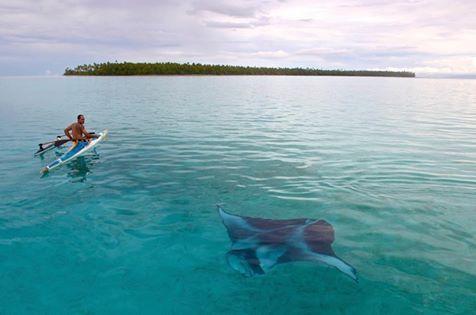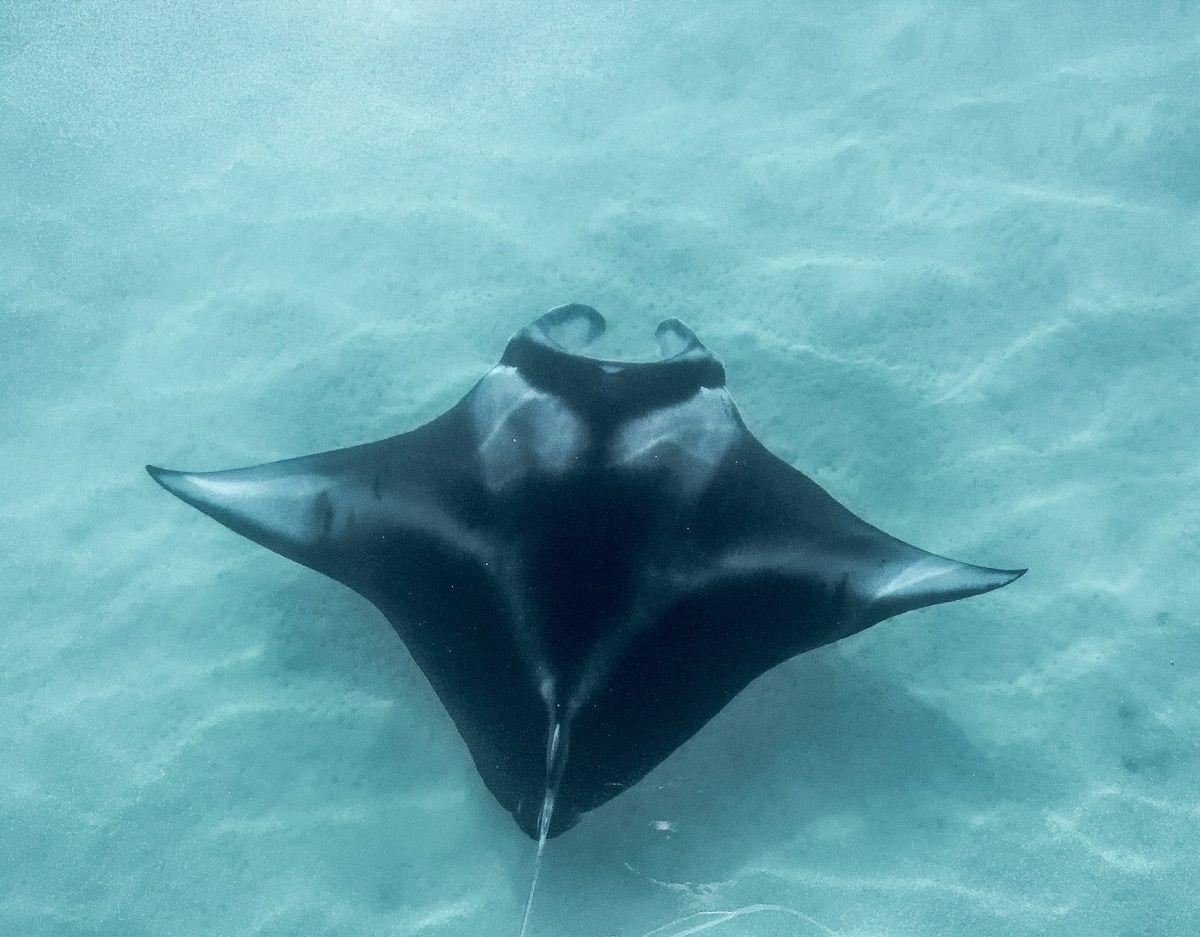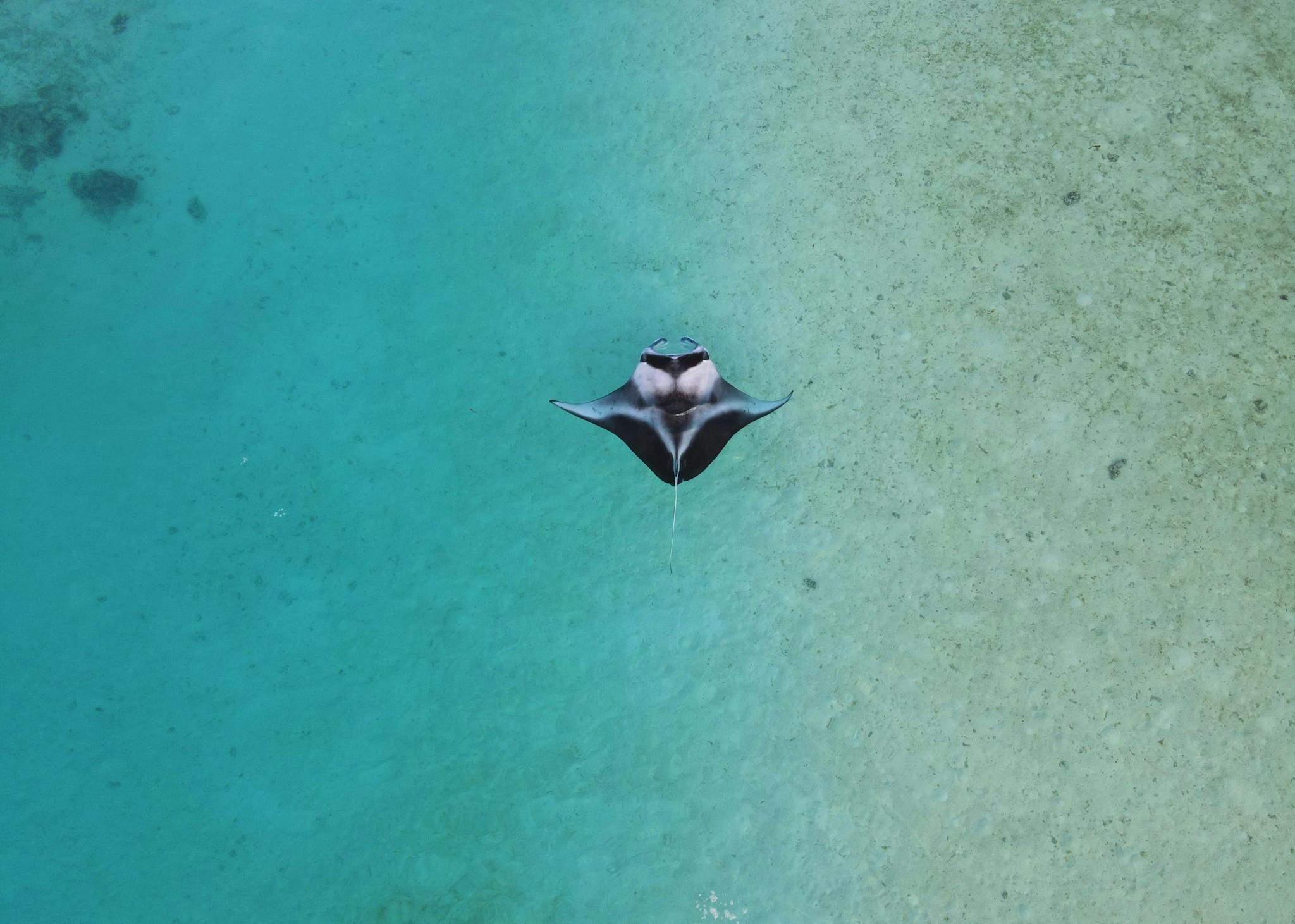
A wide-open mouth turns a passage through the water into a meal of drifting plankton.
- Local names
- Fafa piti
- Where it occurs
- This profile covers manta biology across their range; it does not establish a regular local population or identify every sighting to species.
About this species
The reef manta is Mobula alfredi. It is distinct from the oceanic manta, Mobula birostris, which travels through tropical, subtropical and temperate waters, alone or in groups. Accounts of open-ocean migration belong to that larger relative and should not be read as a record of every manta seen near Tetiaroa.
Mantas feed while swimming, directing water into their broad mouths and filtering out zooplankton. Their food includes tiny shrimp, krill and planktonic crabs.
Mantas visit cleaning stations where other fish remove parasites. They sometimes leap clear of the water, although a single explanation for this behaviour has not been established.
Courtship can involve a male following closely behind a female. Mating males grip a pectoral fin, often the left one, leaving marks that can be seen on females. Breeding timing varies by region. The young develop inside the mother and are born alive after a pregnancy lasting roughly a year.
fr.wikipedia.org/wiki/Manta P. Bacchet, T. Zysman, Y. Lefèvre, 2010. Guide des poissons de Tahiti et ses îles. Au vent des îles. 3e édition.