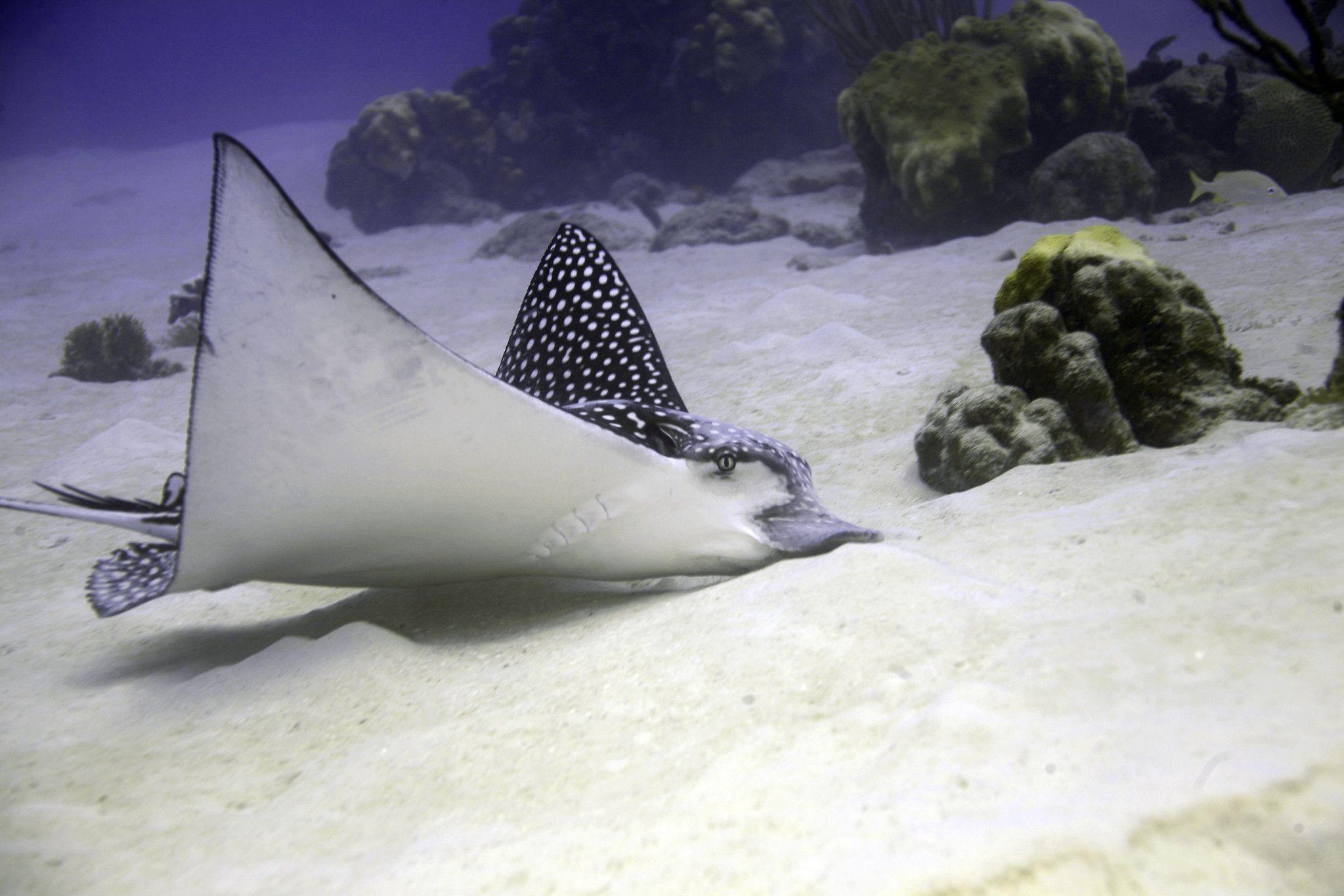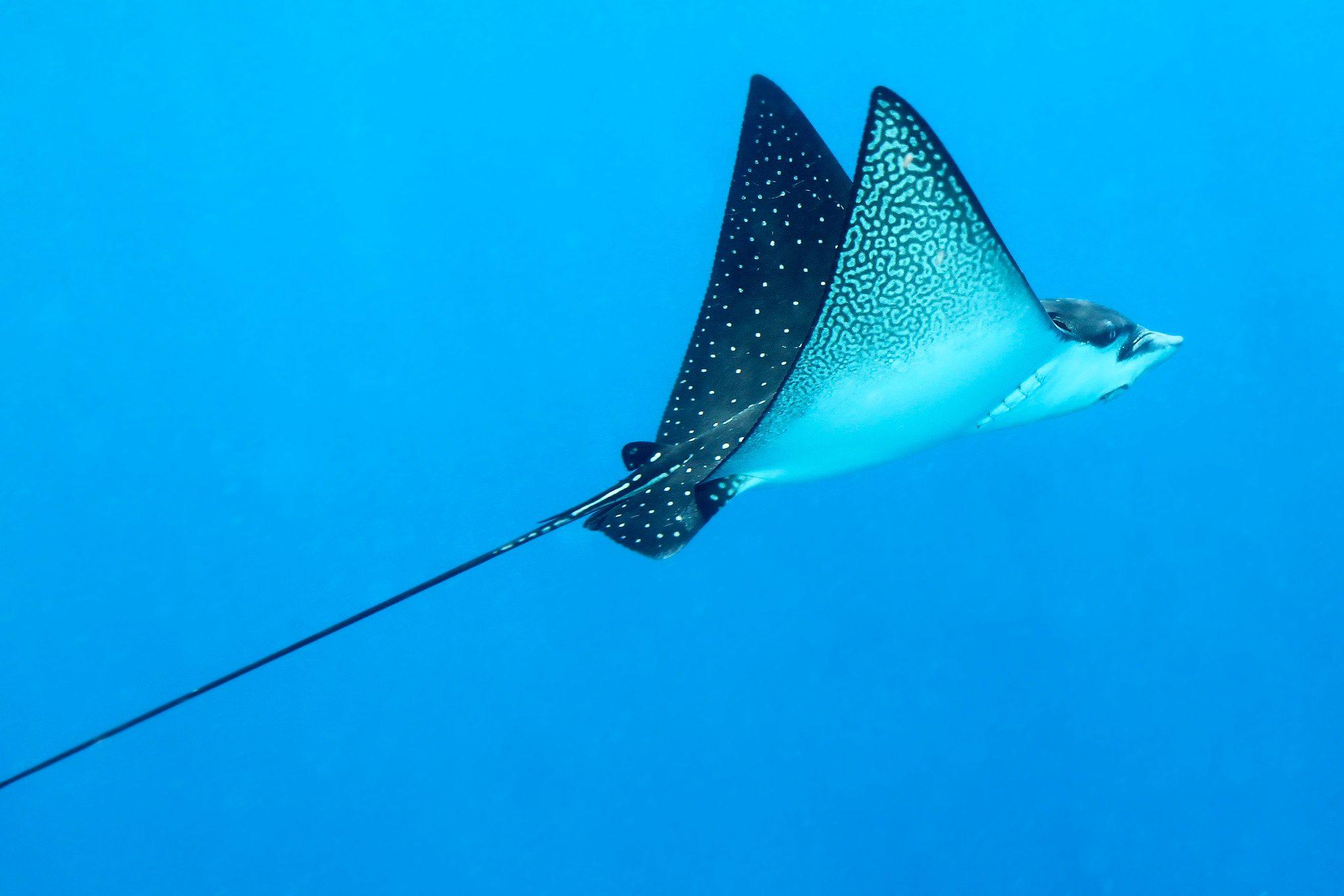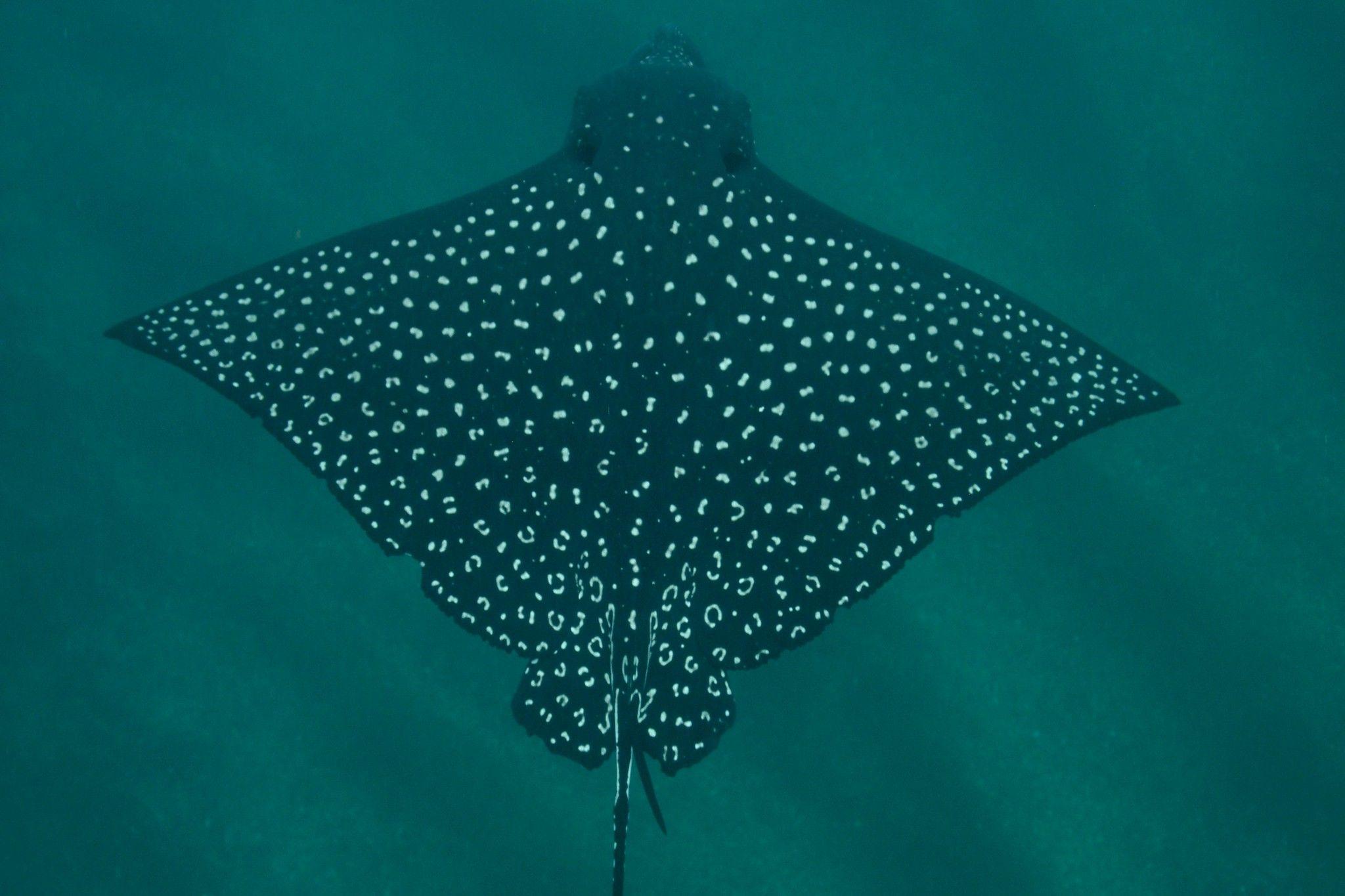
A spotted back passes overhead; below, a duck-bill snout works the sand for hidden shellfish.
- Local names
- Fai manu
- Where it occurs
- The Indo-Pacific spotted eagle ray is Aetobatus ocellatus. Older literature often included it within Aetobatus narinari.
- Other names
- Legacy source name: Aetobatis nari nari
About this species
The flattened, diamond-shaped body is dark blue to almost black above, scattered with white spots, and white underneath. A broad, flattened snout resembles a duck’s bill. Five pairs of gill slits open beneath the body. The long tail can carry several venomous spines behind the pelvic fins.
Large rays may span about 3 m. Older accounts of the spotted-eagle-ray group report total lengths of 5 m, including the tail, and weights up to 230 kg. These are broad species-group figures, not measurements from Tetiaroa.
Eagle rays are often seen together in lagoons and passes. They dig with the snout, sending clouds of sediment out through the gills. Calcified supports reinforce the jaws, while chevron-shaped tooth plates crush hard-shelled prey. Their diet includes bivalves, other molluscs, crabs, hermit crabs, shrimp, worms and other buried animals, octopuses and small fish.
Research reported from Australia and Taiwan found similar feeding patterns between males and females and between the sampled regions.
One or more males may follow a female. A mating male grips her back or a pectoral fin and rolls beneath her so that their undersides meet; the older account describes mating lasting about 30–90 seconds. The male transfers sperm using one of his paired reproductive organs, called claspers. Young develop internally and are born alive.
Accounts formerly grouped under Aetobatus narinari describe gestation of about a year, litters of up to four, newborn disc widths of roughly 17–35 cm and female maturity at around 4–6 years. Such figures need to be read in the context of the former broad species grouping.
- Guide des poissons de Tahiti et ses îles, Indo-Pacific Fish conference Tahiti 2017, P. Bachet, T. Zysman, Y. Lefèvre, Au vent des îles
- DORIS - Aetobatus narinari
- FishBase - Aetobatus narinari