


atoll fern

T.A.R.P. | Yellow Crazy Ant Eradication

Rat and ant volunteers on the way to work

T.A.R.P. | Yellow Crazy Ant Eradication

The yellow-crazy ant (Anoplolepis gracilipes, YCA) is one the 100 worst invasive species in the World according to the IUCN (International Union for the Conservation of Nature). By reaching very high densities and spraying formic acid at any animal on their path, yellow-crazy ants decimate native fauna.

Research Team: Jayna DeVore, Research Engineer, UPF (UMR SECOPOL, Tahiti) | Simon Ducatez, IRD (UMR SECOPOL, Tahiti) | Solène Fabre, Program Coordinator on Tetiaroa | Anaïs Fabre, volunteer | Claire Rocuet, volunteer
Collaborators: Tetiaroa Society
Dates: August 2022 – Ongoing

  Latest progress from the mission of 27 Oct 2025 - 19 Nov 2025

Image
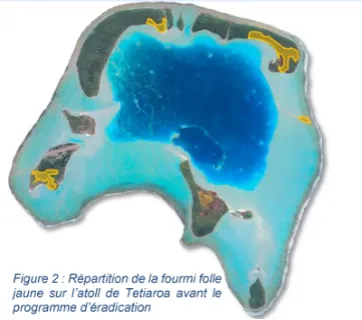
Yellow crazy ants before eradication program

Main objectives

In order to complete post-eradication monitoring for the year 2025, operations were carried out on the motus of Tiaraunu and Onetahi, with monitoring having already been carried out on Aie and Horoatera earlier in the year.

Two monitoring missions were conducted in 2025. The first took place from October 27 to November 3, with Solène Fabre, scientific coordinator of the Tetiaroa Society, accompanied by Anaïs Fabre, who came as a volunteer. The second took place from November 12 to 19, with Solène Fabre accompanied by Claire Rocuet, a former volunteer who had already been involved in similar fieldwork.

Image
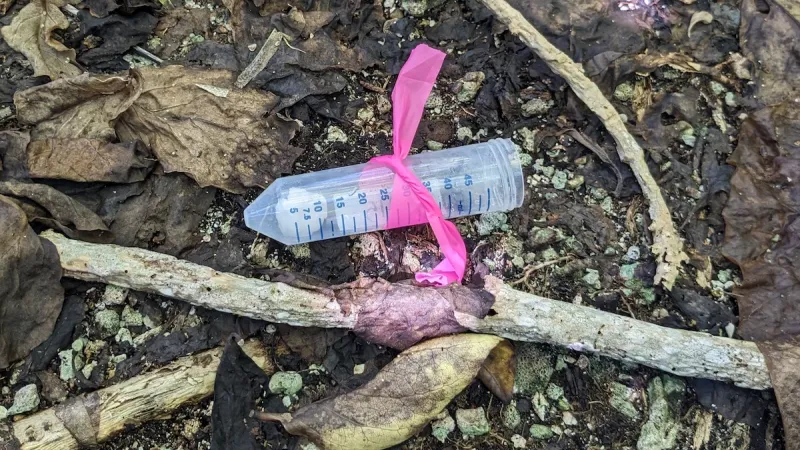
yellow crazy ant bait vial

Summary of Field Activities

The monitoring protocol consisted of placing vials containing cotton balls soaked in sugar solution every 20 meters in previously infested areas. These devices, designed to attract ants, were left in place for about two hours before being checked. The surveys were supplemented by updated mapping to detect any residual presence or signs of recolonization by the yellow crazy ant.

Field conditions occasionally complicated the monitoring process, particularly due to fallen palm fronds and coconuts making some access routes difficult, as well as unfavorable weather conditions. Rainfall and soil moisture slowed down operations, as the protocol ideally requires a rain-free period of at least two hours and relatively dry soil to ensure the effectiveness of observations.

These monitoring operations are particularly tedious and time-consuming due to the density of the network, access constraints, and weather conditions. In this context, the occasional use of volunteers who are already familiar with the terrain ensures the continuity and quality of monitoring, while optimizing the human resources mobilized.

Image
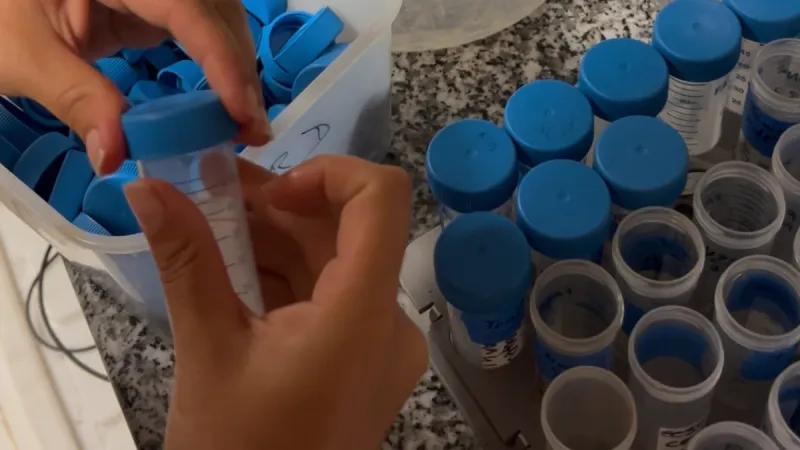
collecting data

Preliminary Results

Surveys conducted during the two missions revealed no detection of yellow crazy ants on the motus of Tiaraunu and Onetahi, confirming the absence of recolonization on these sites at the end of the 2025 annual monitoring period.

Perspectives

Although the results obtained in 2025 are encouraging, vigilance remains essential. Post-eradication monitoring will continue in 2026 and 2027, in accordance with the established protocol, with annual checks of previously infested motus.

This monitoring system, which has already enabled the rapid identification of residual outbreaks and the initiation of corrective treatments in the past, remains essential to ensure the sustainability of eradication efforts on the Tetiaroa atoll.


  Latest progress from the mission of 19 Jun 2025 - 19 Jan 2026

Update: July 19, 2024 from Solene Fabre of the YCA eradication team I am happy to announce that I have completed the mapping in Tiaraaunu to verify the success of the spreading efforts, and I did not detect any yellow crazy ants! This is the third motu where eradication has been successful. The last one to check will be Horoatera (scheduled for October and November).


Project start : August 2022

The yellow-crazy ant (Anoplolepis gracilipes, YCA) is one the 100 worst invasive species in the World according to the IUCN (International Union for the Conservation of Nature). By reaching very high densities and spraying formic acid at any animal on their path, yellow-crazy ants decimate native fauna.

In this project funded by the OFB, the Tetiaroa Society FP aims not only at eradicating the yellow crazy ant from Tetiaroa, but also at testing methodologies that will then be available for other islands of the region (e.g., YCA are now present in all five archipelagoes of French Polynesia, though no successful eradications have been conducted in the region so far). Mapping of the YCA across the atoll and the first baiting tests were carried out in 2022.

This first baiting test had a very strong effect on ants and presented limited undesirable effects on land crabs. So beginning in 2023 we implemented the yellow crazy ant eradication protocol to all invaded areas of the atoll. Baiting was carried out where ants were detected on Motu Onetahi, A’ie, Tiaraunu, and Horoatera by teams of up to 10 volunteers. At the same time, continuous monitoring of the effects of the baiting and of the ant eradication was carried out. By the end of the year monitoring showed the success of the treatments, with ant populations decreasing drastically (>95% reduction) after the first spreading, and no ants being detected in the plots monitored after the second baiting. Monitoring also showed a significant increase (X2) in the number of nesting brown noddies in plots that were deserted by noddies when the ants were present.